September 4, 2026
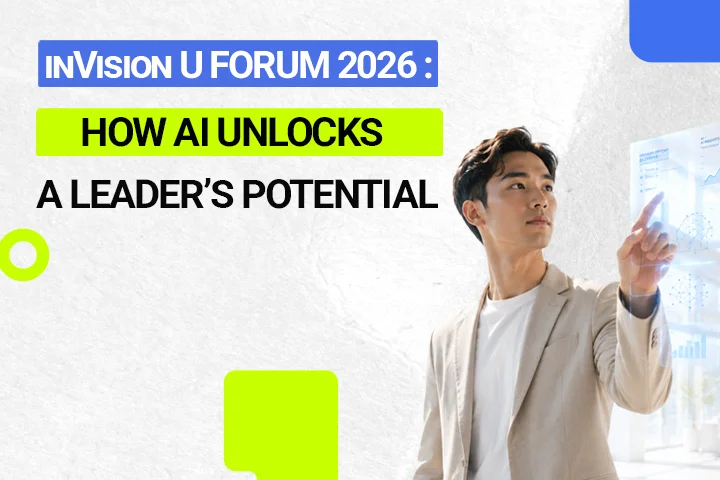
inVision U Forum 2026: How Education and Leadership Are Changing in the Age of AI
Articles
Useful Information

By 2026, more than 60% of higher education institutions in the United States had integrated artificial intelligence into their curricula a 35% increase since 2024. 92% of students use generative AI every week. At the same time, most universities in Kazakhstan are still discussing whether students should be allowed to use ChatGPT at all.
While some are still debating policy, the market has already moved on. In 2026, talking about a digital university is no longer a conversation about LMS platforms and video conferencing. It is about how and when to integrate AI into the learning process. Digital transformation in higher education has moved from the category of a strategic initiative to an operational imperative.
We have to work with what already exists. The market is changing because of AI. The crisis is already here. And universities that continue to pretend that AI does not exist are preparing students for a world that no longer exists.
How Are Educational Standards Changing in the Age of AI?
Today, using AI to create a brief review of a book in ten minutes is sometimes a rational use of time. The review allows you to quickly understand whether a book is worth exploring in depth and to focus on its key ideas.
At the same time, some books are still worth reading in their entirety, and it is up to the university to teach students when a quick survey is OK and when it is a problem.
A university that bans this kind of AI use is not preparing students for the future. But equally, a university that cannot convince them that sometimes you need to slow down and read deeply is also not doing its job.
How the Professional Workflow Is Changing?
- An analyst who used to spend three days collecting data for a report can now do it in three hours with AI.
- A lawyer who once had to read hundreds of precedents can receive a structured analysis within minutes.
- A designer who used to spend a full day creating the first draft of a concept can now generate several options in half an hour.
This does not mean that professionals have become unnecessary. It means that their value now lies elsewhere: in judgment, in asking the right questions, and in making decisions based on what AI provides.
As AI transforms labor markets, acquiring specialized skills is becoming critically important. Choosing well-accredited programs with strong quality standards directly affects a professional's employability and adaptability. The new standard in the labor market is this: an AI-literate professional and a professional without AI skills are not the same position at different levels of preparation.
At inVision U, we bridge this gap by creating AI-literate professionals who also have the deep thinking and analytic skills that separate them from their peers who can only use AI.
How Leadership Is Changing in the Age of AI
Traditionally, a leader was someone who knew more than others. Someone who had access to information that others did not and could make a decision because they understood the context better than everyone else.
AI is disrupting this foundation: information is no longer a scarce resource. A leader whose power is built solely on knowledge is losing their advantage.
“We need to prepare students for a workplace with collective intelligence, where we will work together with AI tools.”
- Javed Aslam, Chief of Artificial Intelligence, Northeastern University.
The Advantages of AI Leadership
- Freedom from routine tasks: leaders delegate to machines the tasks that previously consumed their time and can focus on strategy and people.
- Faster decision-making: there is more data, and it can be processed more quickly.
- Accessible analytical tools: leaders without a deep technical background can now take advantage of advanced analytical capabilities.
- The ability to address global challenges: climate change, sustainability and inequality can be tackled using new tools that were previously unavailable.
Disadvantages and Risks
AI systems make thousands of micro-decisions every day - about customer prioritization, resource allocation and workflow optimization. They can reproduce existing biases at machine speed. AI transformation is continuous, with no stable end state, unlike traditional discrete projects with a clearly defined beginning and end.
When a tool can do in seconds what previously took hours, it raises existential questions about the role and value of human beings. These questions require cultural rather than technical answers and addressing them becomes a leader's responsibility.
What Are Universities Around the World Doing?
AI is moving from experimental use to embedded practice in higher education, but the institutional response remains uneven.
- California State University (CSU), the largest public university system in the United States, deployed the educational version of ChatGPT Edu in the fall 2025 semester for more than 460,000 students and 63,000 faculty members.
Through this initiative, students gained access to personalized tutoring, individualized learning guidance, support in understanding complex concepts, and assistance with academic projects.
- Northeastern University implemented an AI Literacy Framework adapted to each discipline. The implementation follows a bottom-up approach, with representatives from all colleges independently determining what AI readiness looks like in their respective fields.
- South Korea expanded its network of universities providing intensive digital AI programs for employees to 38 institutions.
- Ethiopia opened the first AI University in Africa.
The institutional mandate is clear: move from controlling academic integrity toward ensuring AI literacy.
How inVision U Is Building Education for the Age of AI
inVision U is the first institution in Central Asia where AI is embedded into the educational architecture as a standard - not as an elective or a subject for debate.
- Creative Engineering: AI-assisted CAD/CAM systems, digital twins and automated design.
- Innovative IT Design and Development: AI in product design and UX research using AI-powered analysis of user behavior.
- Sociology: Leadership and Innovation: Big Data for Cities, digital methods for studying social transformations, and the sociology of virality.
- Public Policy and Development: foresight and predictive analytics for public administration.
- Digital Media and Marketing: AI in media production and automation of content analytics.
Students do not study AI as a separate discipline. They work with AI in the context of their specialization exactly as they will in the real labor market.
What Students Choosing a University Right Now Need to Understand
A university that pretends AI does not exist is not protecting its students from an uncomfortable reality. It is depriving them of the tools they need to work in that reality.
inVision U was created with the understanding that education must respond to the demands of the market right now - not five years from now, when “the situation settles down.”
The norms have changed. Leadership has changed. The market has changed. Education must change too.
Join us at inVision U Forum 2026 to stay up to date with upcoming changes and discover what else AI has in store for education in Kazakhstan in 2026. Learn more about the Forum and register for the Forum.
invisionu.education | info@invisionu.education | +7 771 070 73 70
Campus: Almaty, 22/1 Kanysh Satpayev Street, Satbayev University campus.
.webp)