May 15, 2026
Mukhit Kulmaganbetov: From Surgeon to Quantum Researcher
Articles
Useful Information
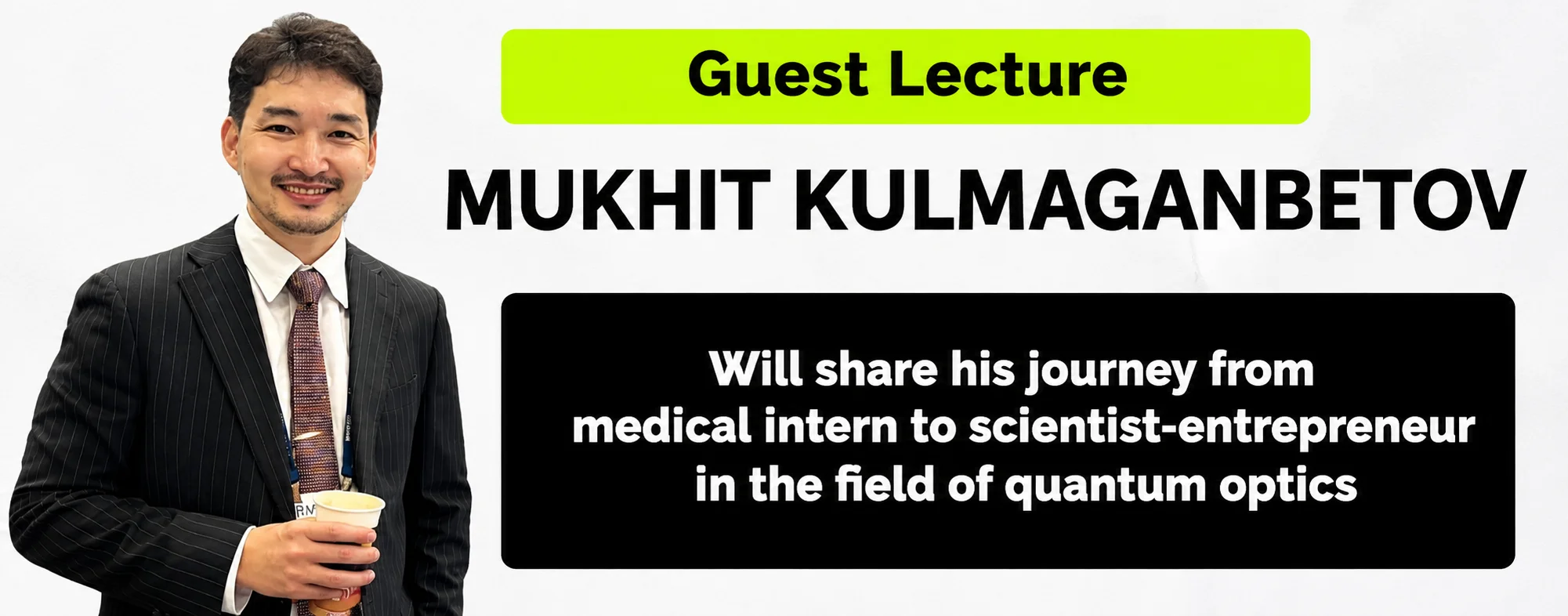
“It doesn’t matter where you’re from — what matters is the direction you’re heading” — the story of Mukhit Kulmaganbetov
Some scientists study the world. Others reinvent it. The hero of this issue belongs to the second group.A PhD in Vision Science, a researcher in quantum optics, an entrepreneur —behind these titles stands a man who is, for the first time in history, applying quantum technologies to ophthalmology. And he’s doing it not for a journal article, but for the billions of people who may one day lose their sight.
Where It All Began
Mukhit became a surgeon. On the surface, it seemed like a straightforward path — a stable profession, respectedby society. But it was in the operating room that he realized: treating what has already happened is not the same as preventing it. Our eyes give us 90% ofthe information about the world around us. And when that channel begins to close, a person doesn’t just lose their sight. They lose their world.
That realization changed everything.
Going Where Others Don’t
When Mukhit was invited to Hong Kong — not for his surgical skills, but for his engineering mindset — he understood he was standing on the threshold of something new. The team needed someone who understood not only diagnoses, but also physics. Someone who didn’t just know what was happening to the eye, but could build an instrument to measure it.
That was the beginning of a journey at the intersection of medicine and quantum science. One of the first in the world. Without a ready-made map and without any guaranteed outcome.
“It doesn’t matter where you’re from — what matters is the direction you’re heading,” says Mukhit.And it’s not a motivational phrase. It’s literally a description of his biography.
The Quantum World Through a Surgeon’s Eyes
Quantum science emerged in the early 20th century — and for a long time existed separately from medicine.Photons — particles of light — do not behave only according to the laws of classical physics. They have parameters: spectrum, polarization, entanglement.And Mukhit asked a question that almost no one before him had asked: what if you directed a modified photon at the eye — and saw what it could reveal?
At the back of the eye lies there tina. On it are axons — cells that perceive light. And there, too, is a molecular pigment that changes long before a person notices anything is wrong.By directing light with specific quantum parameters at it, you can see change sat the molecular level. Earlier than any existing instrument.
This became the foundation of his research. Non-invasive. Painless. Without surgery. Just light — and information we never had before.
A Device That Will Change Ophthalmology
Mukhit is now working on a device for diagnosing molecular degeneration — one of the most socially significant diseases of our time. Hundreds of millions of people already suffer from it. Most find out too late: when central vision has already begun to fade.
The problem is that there is currently no instrument capable of catching this in its early stages. The only existing method — a microscope — offers just one dimension. Mukhit is building something different: a device that will stand in every ophthalmologist’s office within 5–10 years. The prototype is already ready. Ahead lie clinical trials,independent verification, and regulators. It’s a long road. But it has already begun.
In parallel — the startup Eye AI. A software solution for the early diagnosis of vision loss and tunnel vision. The idea is simple and simultaneously revolutionary: it is far better to detect a diagnosis early than to search for treatment afterward.
“If I can help billions of eyes — I’ll definitely be able to help Kazakhstan ones too,” he says, matter-of-factly. Simply as a working task.
On Knowing and Not Knowing
At his lecture, Mukhit said something that surprised many:
“The most important thing is to understand that we are dumb. And to ask questions as often as possible.”
Behind this is not self-deprecation, but the precise position of a scientist: the one who thinksthey know everything stops searching. The one who acknowledges the limits of their knowledge goes further.
That is why Mukhit does internships in different countries. That is why he didn’t stay in surgery, even though he could have. And that is why today his work is noticed in places where no one yesterday would have thought to look for a Kazakhstan scientist.
On Immortality
“There are two kinds of immortality — biological and intellectual. Biological is children. Intellectual is knowledge. Someone, someday, will tell our story.”
Mukhit isn’t building a career for the sake of a career. He’s building something that will last. A device standing in a doctor’s office ten years from now is not just technology. It’s a trace. It’s proof that one person from Kazakhstan once asked the right question— and didn’t stop until they found the answer.
A Message to Those Who Are Just Starting Out
The job market is oversaturated.A foreign degree no longer impresses anyone. Mukhit is direct about this: what matters are skills, and you must prove every single day that you are the best.Not once. Every day.
But what matters most is the desire to actually do something. Not just to know. Not just to have a degree.But to do. To build. To test. To fail and keep going.
“By understanding howphysics and instruments work — I can build anything: a microscope, a camera,whatever I need,” he says. And it’s not boasting. It’s a description of what happens when a person stops dividing the world into ‘their’ and ‘someoneelse’s’ area of knowledge.
The story of Mukhit Kulmaganbetov is part of the Voices of Change series by inVision U. These are conversations with people who haven’t just achieved results, but reimagined how those results are achieved.
Who will be next? Stay tuned for new stories.
Read more useful content on our blog
.webp)