May 18, 2026
Guest Lecture at inVision U: Serik Beisembayev and PaperLab on Sociology
Articles
Useful Information
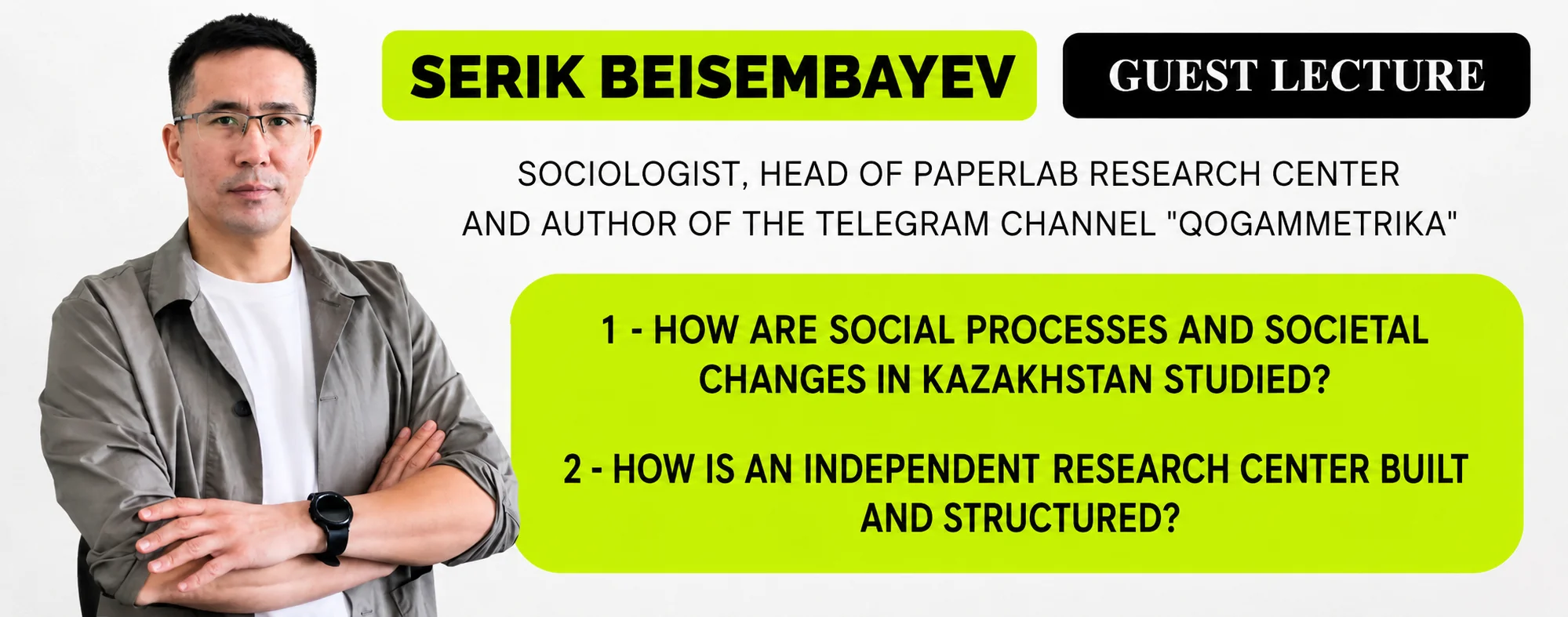
"Sociology is not about having answers. It is about knowing how to ask the right questions." The story of Serik Beisembayev — Guest Lecture at inVision U
There are sociologists who describe society. And there are those who try to understand it — from the inside, without embellishment, without convenient conclusions. Serik Beisembayev is the director of the independent research centre PaperLab, a sociologist with more than 15 years of experience, the author of the Telegram channel Qogammetrika, and one of the few people in Kazakhstan who has turned the study of society into systematic, independent work.
Where It All Began
Serik grew up in the village of Merke in Zhambyl region. The path from a boy in a rural village to the director of a research centre whose work is cited by the Carnegie Endowment and leading Kazakhstani media is neither coincidence nor luck. It is a consistent choice in favour of questions that have no simple answers.
He completed a fellowship at George Washington University, studied the causes of religious extremism in Kazakhstan, and worked in the country's leading analytical institutions. But over time he came to understand: working inside the system and telling the truth about the system are not always the same thing. That is how PaperLab came to life in 2017 — first as a research collective, then as a full-fledged independent centre.
"It is not enough to simply identify a problem — it is important to propose what to do about it." This principle became the foundation of the centre.
How an Independent Research Centre Works
PaperLab is a space where young researchers from Kazakhstan, Kyrgyzstan, and Uzbekistan meet, discuss, and produce knowledge that has practical significance.
The work is built on a multi disciplinary approach: economists, sociologists, and political scientists analyse the same processes from different angles. Both quantitative methods —surveys, statistical analysis — and qualitative ones are used: in-depth interviews, focus groups, document analysis. But the most important thing is not the method itself — it is honesty with the data.
The centre also works to develop the research environment: running training sessions, organising expert discussions, launching internship programmes for emerging analysts. The idea is straightforward: Kazakhstan does not only need good officials and good journalists.It needs people who can ask the right questions and search for answers grounded in evidence.
"In dependence is not only a question of funding. It is a position."
In conditions where independent think tanks across Central Asia operate in an increasingly narrow space,PaperLab remains one of the few centres that speaks publicly about structural issues — from gender inequality to political reform.
At the same time, Serik emphasises: copying Western models is not enough. International methodologies must be adapted to Kazakhstani realities — taking into account language,culture, and social context. It is precisely this local approach, combined with professionalism and a commitment to the values of democracy and human rights,that he believes creates the conditions for genuine social change.
Research That Lives Beyond the Report
One of PaperLab's most recent achievements is its first-ever research internship on public policy conducted entirely in the Kazakh language. Over several months, three young researchers completed specialised training, conducted full field studies, and produced analytical materials on pressing social issues.
- Madina Kanatkyzy studied the problem of sexual harassment in the work place and, as a lawyer, uncovered its legal foundations — proposing specific legislative changes.
- Assem Bazarbek examined the Youth Practice programme: beneath its outwardly positive facade, she identified structural shortcomings and proposed paths toward addressing them.
- Ulzhan Nauryzbai explored decolonisation policy through the lens of the Karlag Museum, demonstrating why museums must be not simply repositories of artefacts but social agents that shape public consciousness.
All three studies were presented in the format of a Research Café in Astana — an open discussion platform where authors meet their audience directly. This is exactly how PaperLab understands the mission of research: not a report filed away in a drawer, but a living conversation with society.
The Craft of Being a Sociologist
At his guest lecture at inVision U, Serik articulated something that is rarely said out loud: sociology is not about having answers. It is about knowing how to ask the right questions.
The main trap for a researcher is to arrive in the field with a conclusion already formed and then simply look for confirmation. Real sociology works differently: data first, interpretation second. And the data often says something that is uncomfortable to hear — for the client and for the researcher alike.
Serik specialises in survey sociology and the study of public opinion. His work addresses how Kazakhstani sperceive political change, how trust in institutions is — or is not — formed,and what national identity looks like in a post-Soviet society.
Another important skill he speaks about is the ability to translate research into language that is accessible not only to fellow academics, but to officials, journalists, and ordinary citizens.Knowledge that remains inside the academy does not change reality.
A Message to Those Who Want to Study Society
Serik says this without ceremony.Kazakhstan needs researchers: not those who can produce a well-formatted report, but those who can think independently. Who are prepared to acknowledge when data disproves a hypothesis. Who are not afraid to say something uncomfortable.
"I am very proud of our team at PaperLab. We are gradually building a professional research environment made up of young scientists. I believe that together we will make a significant contribution to our field."
Serik Beisembayev's story is part of the Voices of Change series at inVision U. These are conversations with people who have not just achieved results — but rethought how those results are reached.
Who will be the next guest? Stay tuned for new stories.
.webp)